
TWO:CADIZ.In the course of this commercial madness the imports greatly exceeded the exports, and there was consequently a rapid drain of specie from the country. The drain of bullion from the Bank of England was immense. In August, 1823, it had ¡ê12,658,240, which in August, 1825, was reduced to ¡ê3,634,320, and before the end of the year it ran as low as ¡ê1,027,000. Between July, 1824, and August, 1825, twelve millions of cash were exported from Great Britain, chiefly to South America. During the Revolutionary war, which had lasted for fourteen years, the capital of the country had been completely exhausted, while all productive labour had been abandoned. The unworked mines were filled with water. They were accessible, it is true, to English speculators, but they were worked exclusively with English capital. The South American mining companies were so many conduits through which a rapid stream of gold flowed from Great Britain. The catastrophe that followed took the commercial world by surprise; even the Chancellor of the Exchequer failed to anticipate the disaster. On the contrary, his Budget of 1825 was based upon the most sanguine expectations for the future, and on the assurance that the public prosperity was the very reverse of what was ephemeral and peculiar, and that it arose from something inherent in the nation. Even at the prorogation of Parliament in July, the Royal Speech referred to the "great and growing" prosperity on which his Majesty had the happiness of congratulating the country at the beginning of the Session. The commercial crisis, however, with widespread ruin in its train, was fast coming upon Britain. Vast importations, intended to meet an undiminished demand at high prices, glutted all the markets, and caused prices to fall rapidly. Merchants sought accommodation from their bankers to meet pressing liabilities, that they might be enabled to hold over their goods till prices rallied. This accommodation the bankers were unable to afford, and sales were therefore effected at a ruinous loss. The South American mines, it was found, could not be worked at a profit, and they made no return for the twenty million pounds of British money which they had swallowed up. The effect was a sudden contraction of the currency, and a general stoppage of banking accommodation. The country banks, whose issues had risen to ¡ê14,000,000, were run upon till their specie was exhausted, and many of them were obliged to stop payment. The Plymouth Bank was the first to fail, and in the next three weeks seventy banks followed in rapid succession. The London houses were besieged from morning to night by clamorous crowds, all demanding gold for their notes. Consternation spread through all classes. There was a universal pressure of creditors upon debtors, the banks that survived being themselves upon the edge of the precipice; and the Bank of England itself, pushed to the last extremity, peremptorily refused accommodation even to their best customers. Persons worth one hundred thousand pounds could not command one hundred pounds; money seemed to have taken to itself wings and fled away, reducing a state of society in the highest degree artificial almost to the condition of primitive barbarism, which led Mr. Huskisson to exclaim, "We were within twenty-four hours of barter."
THREE:But though the 21st of January was to be the day of the grand attack on the Ministry, the battle was not deferred till then. Every day was a field-day, and the sinking Minister was dogged step by step, his influence weakened by repeated divisions, and his strength worn out by the display of the inevitable approach of the catastrophe. The first decided defeat that he suffered was in the election of the Chairman of Committees. The Ministerial candidate, Giles Earle, was thrown out by a majority of two hundred and forty-two to two hundred and thirty-eight, and the Opposition candidate, Dr. Lee, was hailed by a shout that rent the House. Other close divisions followed. The fall of Walpole was now certain, and he would have consulted both his dignity and comfort in resigning at once. This was the earnest advice of his friends, but he had been too long accustomed to power to yield willingly. He was oppressed with a sense of his defeats, and the insolence of enemies whom he had so long calmly looked down upon without fear. He was growing old and wanted repose, but he still clung convulsively to his authority, though he had ceased to enjoy it.
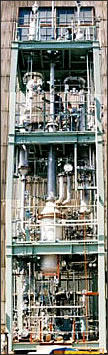
High quality is being demanded in many fields nowadays and so in order to satisfy that we developed a high-purity distillation system in collaboration with Ube industries, Ltd. and Kanto Chemical Co., Inc. The system is used to refine cleaning solutions for the semiconductor industry, medical materials, etc. of high purity (residual ion concentration: 0.01 to 1.0 ppb).
- Our High-purity distillation system provide our clients with high solvent recovery rate, almost 100%.
- The quality of the products/output from our system is very stable, which makes production management very easy, and easier than the conventional ion exchange resin method.
- No emission of waste brings our clients reduction of running cost for environmental measures.
- Our various devices minimize entrainment.
- To prevent the elution of metal, you could ask us the system made of Teflon.
- Our High-purity distillation system has been already proved for solvents that trigger very rapid decomposition reactions, such as hydrogen peroxide.
- Product guide
- Alcohol distillation
- Distillation equipment
- High-purity distillation system
- Membrane separation type solvent dehydration system
- Reactor
- Evaporative concentration equipment
- Coulter spray dryer
- Microwave treatment system
- Filter dryer
- OS filter (continuous vacuum rotating filter)
- Hydrocyclone (liquid cyclone)
- Thermal oil heater (heat medium boiler)
- Process air heater (air heater)
- Ammonia treatment system
- Catalytic deodorizing equipment for ammonia and VOC gas
- Stationary cryogenic storage tank
- Portable cryogenic container
- Cryogenic liquefied gas evaporator